
Best Shopify Returns Apps to Reduce Churn

Last verified: May 2026
Key takeaways
- The average e-commerce return rate sits at nearly 21% — without a dedicated returns app, that's a significant chunk of revenue quietly leaking out the back door.
- The best returns apps convert refunds into exchanges or store credit, keeping cash inside your business instead of sending it back to the customer's bank account.
- Look for: a self-service customer portal, automated return rules and label generation, and a real-time analytics dashboard that tells you why products are coming back.
- Loop Returns suits high-volume brands that need exchange-first flows; AfterShip Returns suits brands wanting an affordable all-in-one post-purchase platform; ReturnGO suits those wanting heavily automated, AI-driven workflows.
- Returns data is one of the most underused inventory signals — feed it back into your purchasing decisions and you'll meaningfully reduce dead stock over time.
One in five orders gets returned. That's the rough reality for most Shopify stores right now, and it compounds fast. If you're doing £500,000 in annual revenue, you're probably processing around £100,000 worth of returns. How you handle those returns determines whether that £100k is a cost centre or a partial revenue recovery.
Most stores still handle returns reactively. A customer emails in, support digs up the order, a label gets sent manually, a refund gets issued. The whole thing takes 20 minutes per case. Multiply that by a few hundred returns a month and you've got a serious operations problem — one that scaling DTC brands solve early, not late.
This article covers the best Shopify returns apps available in 2026 — what each one does well, who it's actually built for, and how to pick the right one. We looked at four tools in depth, plus a quick note on a fifth. No invented features, no padded comparisons.
Why your Shopify store needs a dedicated returns app
Shopify does have a built-in returns system. It handles basic return requests and refunds natively. But it's bare-bones. There's no self-service portal for customers, no automated rules engine, no label generation at scale, and no analytics to tell you that your size-M hoodies are coming back at three times the rate of everything else.
A dedicated app fills all of those gaps. More importantly, the best ones shift the frame entirely — instead of processing refunds, they're designed to deflect refunds into exchanges or store credit. That's where the real value sits. When we were running our own brands, we found that a well-designed exchange flow could recover 20–30% of return revenue that would otherwise have walked out the door. No heroic customer service required. Just a better-designed post-purchase experience.
And the operational savings are real. Automated returns management can dramatically cut handling time per return and reduce inbound support contacts — both of which translate directly to headcount savings or, more likely, your existing team getting to focus on higher-value work.
Key features to look for in a Shopify returns app in 2026
Not all features are equal. Here's what actually matters:
- Self-service returns portal — Customers should be able to initiate a return without emailing your support team. This alone eliminates a huge volume of repetitive tickets.
- Automated return rules — Return windows, eligible product categories, condition requirements — these should run on rules, not manual review.
- Automated label generation — Multi-carrier support matters here, especially if you're shipping across multiple markets. See also our guide to shipping software for e-commerce for context on carrier integrations.
- Exchange and store credit flows — The ability to offer an incentivised exchange (bonus credit, instant exchange) is the single highest-leverage feature for revenue retention.
- Return analytics — Which SKUs are coming back? What reason codes are customers selecting? This data feeds directly into smarter inventory management and purchasing decisions.
- Fraud detection — Return fraud is a real and growing problem. Automated item validation and flagging saves you money at volume.
The best Shopify returns apps compared
Loop Returns
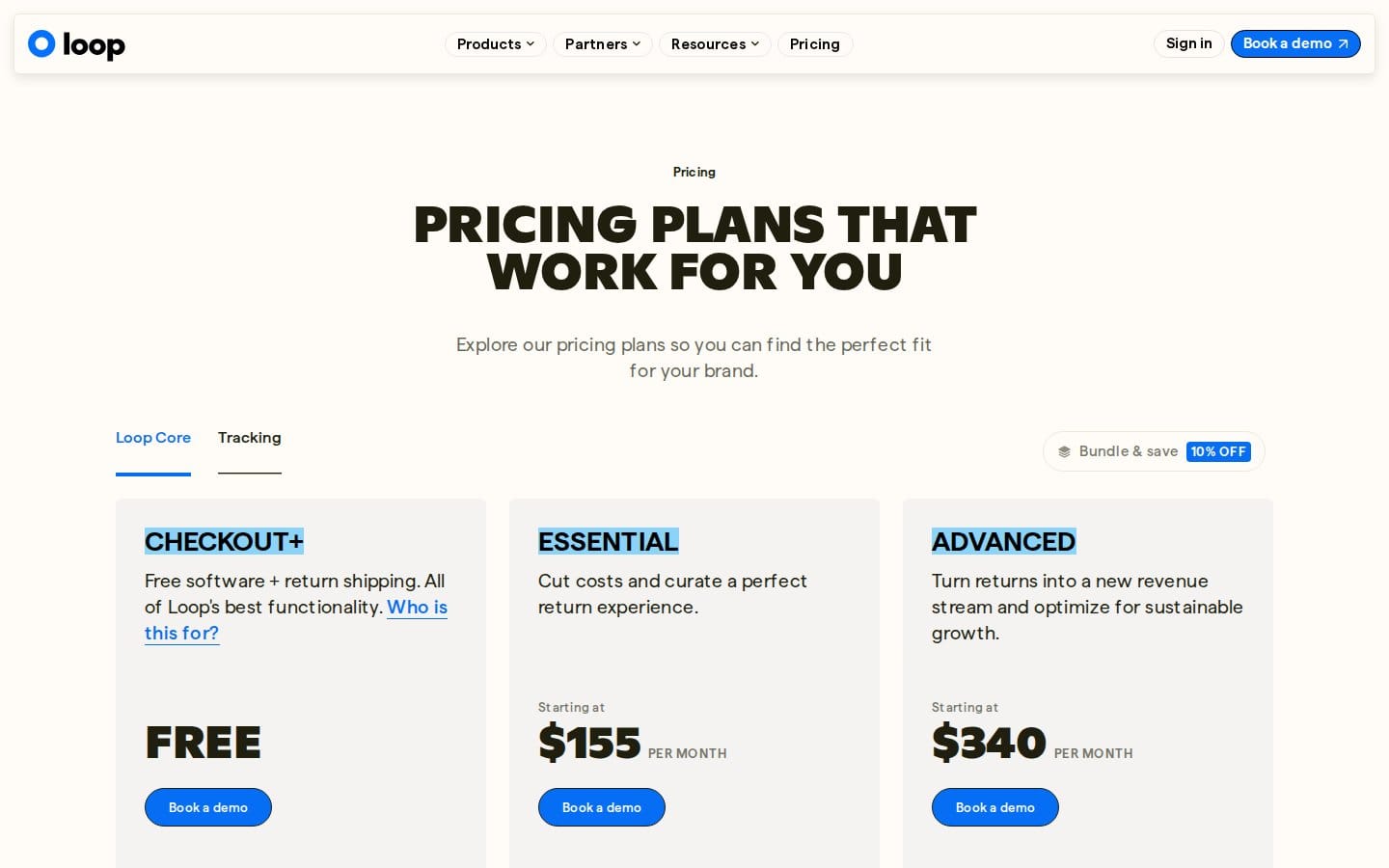
Loop Returns is the most exchange-focused returns solution in this list. Where most tools treat the return as a problem to manage, Loop treats it as a revenue-retention opportunity. Its entire UX is built around nudging customers toward exchanges rather than refunds — features like Shop Now (letting customers apply return credit to any item in your store) and Instant Exchange (sending the replacement before the return is even processed) are the core of what it does. It also covers order tracking and includes fraud detection on the higher plans.
Strengths
- Exchange-first return flow with Shop Now and Instant Exchanges — the deepest revenue-retention feature set in this roundup.
- Automated return policies and workflows reduce manual intervention across the entire returns lifecycle.
- Fraud detection on the Advanced plan protects high-volume stores from systematic return abuse.
Best fit
Loop works best for high-volume Shopify brands that care more about keeping revenue through exchanges than processing fast refunds. Worth noting: order tracking pricing scales with monthly shipment volume — there's a flat fee for estimated shipments and a per-shipment charge beyond that, so factor that in when modelling total cost.
AfterShip Returns
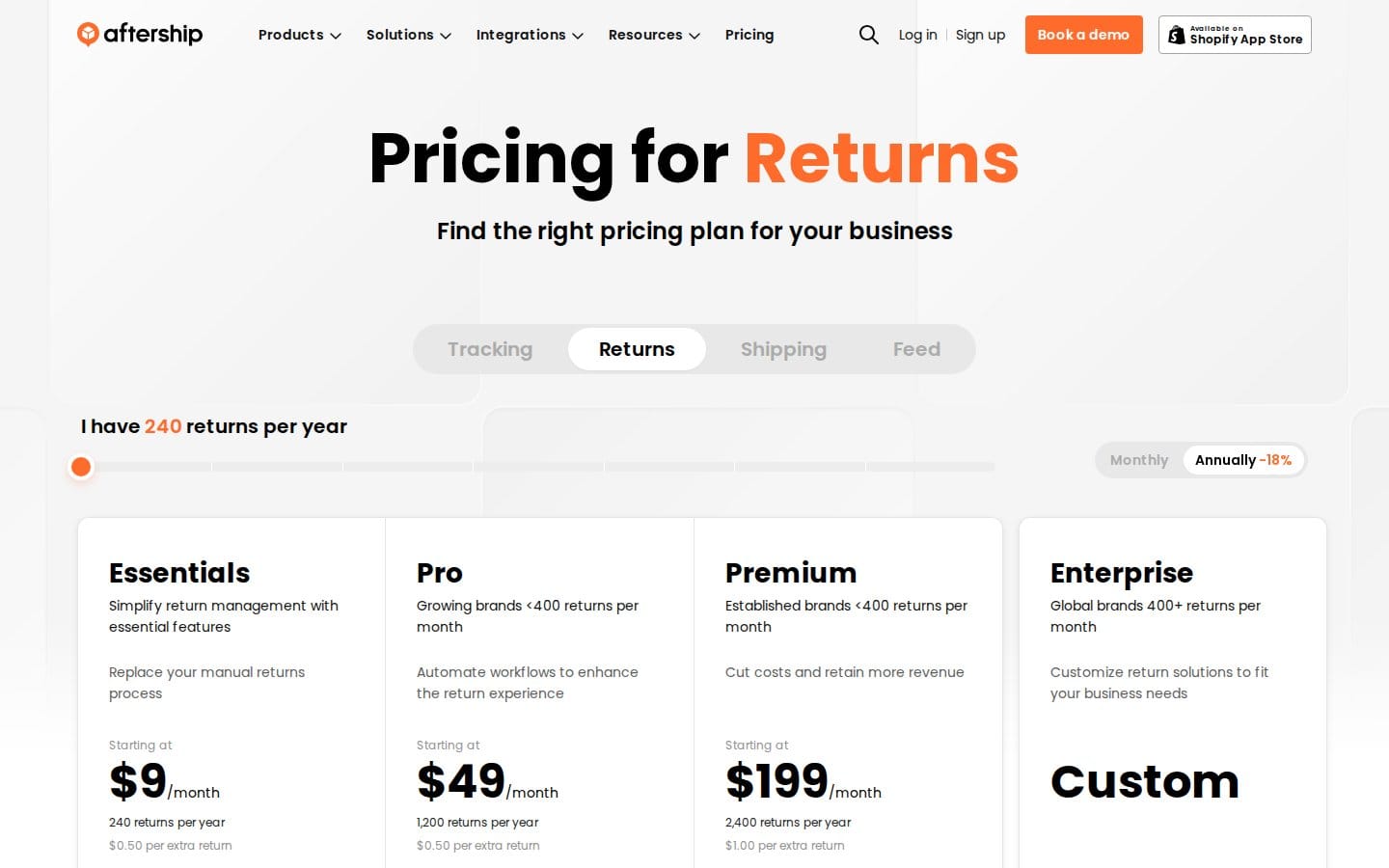
AfterShip Returns sits inside the broader AfterShip ecosystem — which also covers shipment tracking, delivery notifications, and more — making it a practical choice for brands that want one platform managing the full post-purchase experience. The returns module includes a branded returns page, automated processing, real-time return shipment tracking, and incentivised exchange and store credit flows. There's a free tier, and paid plans are structured around annual return volume rather than feature gating.
Strengths
- Branded returns page keeps the customer experience consistent through the post-purchase journey.
- Automated returns processing and resolution workflows cut down on manual handling time.
- Incentivised exchanges and store credits give you the core revenue-retention tools most growing stores need.
Best fit
AfterShip Returns suits e-commerce brands that want to automate returns inside a broader post-purchase toolset. Be aware that all pricing tiers have an annual returns cap — returns beyond your plan's allowance incur an additional per-return fee, so model your volume carefully before committing.
ReturnGO
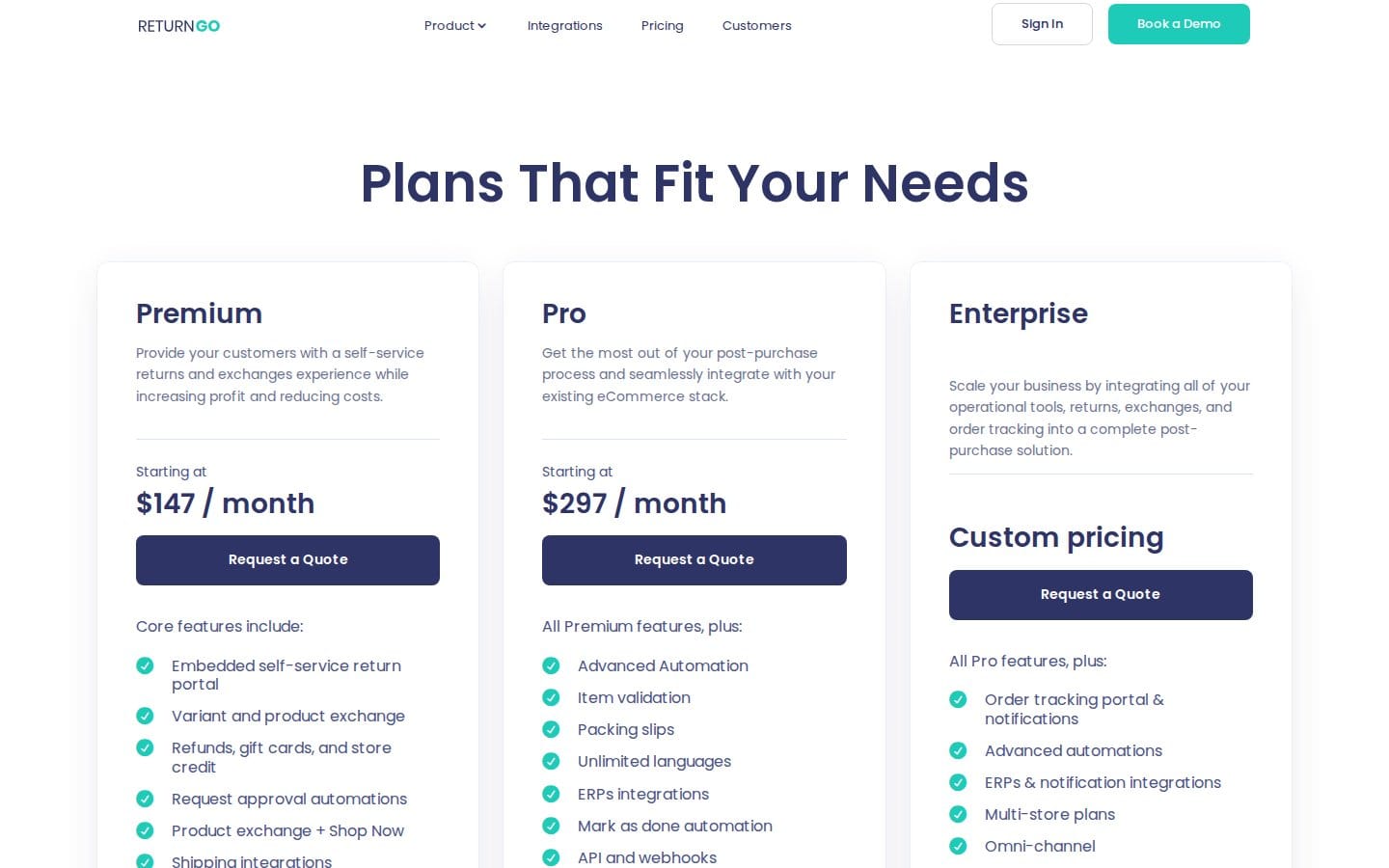
ReturnGO leans heavily into automation and configurability. The rules engine is genuinely flexible — you can set up complex conditional logic for return eligibility, resolution types, and routing without writing a line of code. The branded self-service portal embeds directly into your store, keeping the experience native rather than redirecting customers to a third-party subdomain. It also covers multi-carrier label generation, a real-time analytics dashboard, and item validation to reduce fraudulent or ineligible returns.
Strengths
- Automated returns and exchanges with highly customisable rules and workflows — well suited to brands with complex return policies across product categories.
- Revenue retention tools including exchanges, store credit, and Shop Now functionality.
- Real-time return analytics dashboard gives operations teams actionable data on return reasons and trends.
Best fit
ReturnGO works well for e-commerce businesses that want deep automation and a branded self-service post-purchase experience. The Starter tier is capped at 20 returns per month, with excess returns charged at £1.25 each — fine for testing, not for anything beyond very early-stage volume.
Rich Returns
Rich Returns takes a cleaner, more straightforward approach than some of the more feature-heavy platforms in this list. It's built specifically for Shopify merchants, with a custom-branded returns portal, automated prepaid return labels from 50+ carriers, and an exchange-first design that pushes store credit and swaps ahead of refunds. Automated approval rules handle eligibility checks without manual review. Integrations include Shippo, ShipStation, EasyPost, and Stripe — which covers most common Shopify operational stacks.
Strengths
- Self-service, custom-branded returns portal built natively for Shopify — no generic third-party redirect.
- Automated prepaid return labels from 50+ carriers, reducing friction for international or multi-carrier operations.
- Exchange-first design to encourage product swaps or store credit over straight refunds.
Best fit
Rich Returns is built for Shopify merchants that want to automate returns and exchanges with a clean, carrier-flexible setup. The Starter tier is limited to 10 monthly returns — a useful free entry point, but most active stores will outgrow it quickly.
At a glance
| Tool | Best for | Free tier | Key integration |
|---|---|---|---|
| Loop Returns | High-volume brands prioritising revenue retention through exchanges | Yes (Checkout+) | Shopify, Gorgias, Klaviyo, NetSuite |
| AfterShip Returns | Brands wanting an all-in-one post-purchase platform | Yes | Shopify, ShipBob, FedEx, USPS |
| ReturnGO | Brands needing AI-powered automation and complex return rules | No | Shopify, NetSuite, Gorgias, Zendesk |
| Rich Returns | Shopify merchants wanting a clean, carrier-flexible exchange-first setup | Yes (10 returns/mo) | Shopify, Shippo, ShipStation, EasyPost |
How to choose the right returns app for your store
The honest answer is it depends on your return volume, your primary pain point, and how complex your return policy actually is.
If your main problem is revenue leakage — too many refunds going out the door — Loop Returns is the most purpose-built solution for that specific problem. Its exchange-first flows are more developed than any competitor in this list. But it's also the priciest option for early-stage stores, so weigh that honestly.
If you want a single platform covering tracking, notifications, and returns without stitching together multiple tools, AfterShip Returns makes sense. The free tier is a legitimate starting point, not just a lead magnet with the useful features locked away.
If you're running a brand with complex return logic — different rules by product type, geography, or sales channel — ReturnGO's rules engine is the standout. It handles conditional logic that most other tools can't match without custom development.
And if you're a Shopify-native brand that wants straightforward automation without a steep learning curve, Rich Returns delivers the essentials cleanly. For fashion brands in particular, the exchange-first logic is especially relevant — sizing returns are the single biggest driver of return rates in apparel, and fashion brands selling into EU markets face additional product labelling and compliance obligations that compound the operational complexity of returns management.
Connecting returns data to your inventory management
Here's something most brands miss entirely: returns data is inventory intelligence.
When 15% of a specific SKU is coming back with the reason code "not as described", that's not a customer service problem — it's a product listing problem, possibly a supplier quality problem. When a particular colourway is being returned at twice the rate of others, that tells you something about your next purchase order. This is exactly the kind of signal that feeds into smarter multi-channel inventory management — knowing which products to reorder conservatively and which listings need immediate attention.
The returns analytics dashboards in Loop, ReturnGO, and AfterShip all surface this kind of data. But it only becomes useful if someone is actually reading it and feeding the insights back into purchasing and merchandising decisions. Building a monthly returns review into your operations cadence — alongside your reorder workflow and your purchase order process — is one of the higher-ROI operational habits a growing brand can develop.
If you're selling across Shopify and Amazon simultaneously, the picture gets more complex. Return rates and reasons can diverge significantly between channels, which means your inventory reorder decisions need to account for channel-specific return behaviour. We cover the multi-channel side of this in our guide to syncing Shopify and Amazon inventory.
Frequently asked questions
Does Shopify have a built-in returns system?
Shopify has a native returns system that handles basic return requests and refunds directly from the admin. It works at very low volumes, but it has no customer self-service portal, no automated return rules, no label generation at scale, and no meaningful analytics — all of which a dedicated third-party returns app provides.
How do I automate my return process on Shopify?
Return automation on Shopify runs through third-party apps from the Shopify App Store. These apps let you set up rules for return eligibility, auto-approve or reject requests based on those rules, generate prepaid shipping labels automatically, and trigger refund or store credit resolutions without manual intervention. Loop Returns, AfterShip Returns, and ReturnGO all offer this level of automation.
What is the best return policy for an e-commerce store?
The best return policy is clear, fair, and subtly designed to favour exchanges over refunds. A 30-day window is standard for most product categories; offering bonus store credit as an incentive to choose an exchange over a cash refund is a proven tactic for retaining revenue. For fashion brands specifically, clear sizing guidance upfront reduces return rates more than any post-purchase policy adjustment — and if you're selling into EU markets, your return policy needs to align with applicable consumer protection regulations.
How can I turn returns into exchanges on Shopify?
Apps like Loop Returns, AfterShip Returns, and ReturnGO all offer exchange flows that present customers with alternatives to a cash refund — swapping for a different size or colour, selecting a different product entirely (Shop Now), or taking store credit with a bonus incentive. The key is making the exchange option visually prominent and frictionless in the returns portal. When the exchange path is easier than the refund path, a meaningful share of customers will take it.
Which returns app should you pick?
If revenue retention is your primary goal and you're doing serious volume, Loop Returns is the most purpose-built tool for that outcome. For brands that want a capable, affordable solution that grows with them without complexity overhead, AfterShip Returns offers the best balance of features and accessibility. ReturnGO earns its spot for brands with genuinely complex return logic that other tools can't configure without workarounds. And Rich Returns is a solid, no-fuss option for Shopify-native stores that want the essentials done well.
Returns management is one of those operational areas that tends to get deferred until it's actively causing pain. But the brands that treat it as a revenue system rather than a cost — building exchange flows, mining return data, and feeding insights back into their inventory strategy — consistently come out ahead. Any of the tools above will move you significantly further along that path than managing returns manually.
Screenshots are from each tool's public pricing or features page, captured May 2026. We are not affiliated with any third-party tool listed unless explicitly noted.