
Textile EPR Compliance: A 2026 Guide for Apparel Brands

July 1, 2026. That's the date most apparel brands have circled in red — because that's when the EU ban on destroying unsold clothing takes effect for large companies, and when California's Responsible Textile Recovery Act requires producer registration. Two major markets. Same deadline. And most brands we speak to still don't have a plan.
Textile EPR compliance isn't a future problem anymore. It's a right-now operational challenge that touches your inventory strategy, your product design, your reporting infrastructure, and your relationship with every market you sell into. We've spent a lot of time working through this with apparel brands, and the honest truth is: the brands that are panicking are the ones that treated this as purely a legal issue. The ones who are calm built it into their operations months ago.
This guide covers what you actually need to do — across the EU and the US — to meet your obligations in 2026 and beyond. We've also written a broader guide to EPR compliance across product categories if you sell more than just apparel.
Why Textile EPR is a Critical E-commerce Issue in 2026
Extended Producer Responsibility shifts the cost of end-of-life waste management from governments (and taxpayers) onto the companies that put products into the market. For textiles, that means if you manufacture or import clothing, footwear, or accessories into covered markets, you're financially and operationally responsible for what happens when those products are worn out, returned, or discarded.
This matters especially for e-commerce brands because the "distance selling" rules that once created grey areas are gone. Selling into France from a Shopify store in London doesn't exempt you from French obligations. Selling into California from a warehouse in Nevada doesn't exempt you from SB 707. The principle is consistent across jurisdictions: if you're placing product on a market, you're a producer under EPR law, full stop.
And the stakes are real. Non-compliance in Germany under the VerpackG model (which informs how textile EPR is being structured across the EU) can result in sales bans — not fines, actual prohibition on selling. California's Responsible Textile Recovery Act (SB 707) similarly gives enforcement teeth to the California Department of Resources Recycling and Recovery (CalRecycle).
Look, there's also a commercial dimension here that's easy to miss. The eco-modulated fee structures being adopted across EU member states mean your compliance costs are directly tied to how sustainably your products are designed. A t-shirt made from a mono-material like 100% organic cotton attracts lower fees than one blended with elastane that can't be mechanically recycled. That's not just a compliance concern — it's a product design incentive with real financial implications, and we'll get into the specifics below.
For brands managing inventory across multiple channels, compliance reporting also depends heavily on having accurate, real-time data on what you've sold, where, and in what quantities. If your inventory sync across channels isn't reliable, your EPR reporting won't be either.
Understanding Key Regulations: EU Waste Framework Directive & US State Laws
The EU Revised Waste Framework Directive
The EU's revised Waste Framework Directive (rWFD) makes harmonised EPR schemes for textiles mandatory across all 27 member states, with full implementation required by 2028. Member states that hadn't already established national textile EPR programmes were required to begin rolling them out from January 2025. France was the trailblazer here — its Refashion scheme (formerly Eco TLC) has been operating since 2007 and serves as the template much of the rest of the EU is following.
Under the rWFD framework, producers (manufacturers, importers, and distance sellers) must:
- Register with an approved Producer Responsibility Organisation (PRO) in each member state where they place product
- Pay annual eco-modulated fees based on the weight and sustainability profile of products sold
- Report quantities and material composition of products placed on each market
- Contribute to or arrange textile collection infrastructure
France's Refashion scheme currently uses a tiered fee structure where fees per tonne are modulated based on criteria including recyclability, use of recycled content, durability signalling (e.g., repairability index scores), and country of production. Brands with high recycled content and mono-material construction pay less per tonne. The financial difference between an optimised and unoptimised product range can be substantial for higher-volume sellers.
The July 2026 destruction ban deserves its own paragraph. Starting July 1, 2026, large companies operating in the EU are prohibited from destroying unsold apparel. "Large" here follows EU Accounting Directive thresholds — broadly, companies with over €40 million in net turnover or over €20 million on the balance sheet. This forces a rethink of end-of-season inventory strategy: you can't just write off and landfill slow-movers. Resale, donation, and recycling channels need to be part of your reverse logistics operation before the deadline.
US State Laws: California Leads, Others Follow
California's SB 707 (Responsible Textile Recovery Act) is the first enacted US state textile EPR law. Producer registration with CalRecycle opened in early 2026, with the registration deadline set for July 1, 2026. Producers above de minimis thresholds — broadly, those selling above a defined revenue floor into California — must register and join a Stewardship Organisation to fund collection and recycling infrastructure.
New York's Fashion Sustainability and Social Accountability Act (the Fashion Act) and Washington State's proposed textile EPR bills are at various stages of legislative progress as of April 2026. New York's bill would require large fashion companies (over US$100 million in global revenue) to map and disclose their supply chains and set science-based targets — which overlaps with but is distinct from the EPR fee-and-register model. Washington's proposals are closer to California's structure.
For a brand selling across the EU and the US, the regulatory picture looks like this:
| Jurisdiction | Regulation | Key 2026 Deadline | Fee Structure | Scope |
|---|---|---|---|---|
| France | Refashion (rWFD) | Annual declaration by April 30 | Eco-modulated per tonne; reduced for recyclability, recycled content | Clothing, footwear, household linen, curtains |
| Germany | rWFD transposition (in rollout) | Full national scheme by 2028 | To be set by national PRO; expected eco-modulated | Clothing and textiles; household textiles |
| Netherlands | UPV Textiles | Annual reporting; registration ongoing | Fee per kg based on material category | Clothing, home textiles, shoes |
| California (US) | SB 707 | Producer registration: July 1, 2026 | Stewardship fee; structure set by approved organisation | Apparel, footwear, accessories, household textiles |
| New York (US) | Fashion Act (proposed) | Pending enactment | Supply chain disclosure + targets; not a fee-based EPR | Fashion companies >$100M global revenue |
Your Obligations: A Checklist for Online Apparel Sellers
Frankly, most brands overthink the complexity and underthink the execution. Your obligations break down into four operational tracks: registration, fee payment, take-back, and reporting. Here's a practical checklist.
Step 1: Determine Where You're Obligated
You're a "producer" in any jurisdiction where you sell product — not just where you're incorporated. Map your sales by market, not by your warehouse location. If you sell into France, Germany, and the Netherlands through your Shopify store, you have obligations in all three. If you sell into California, SB 707 applies regardless of where your US entity is based.
Step 2: Register with a PRO in Each Market
- France: Register with Refashion (refashion.fr). Membership is mandatory for any producer placing more than de minimis quantities of textiles on the French market.
- Netherlands: Register under the UPV (Uitgebreide Productenverantwoordelijkheid) textiles scheme with an approved Dutch PRO.
- Germany: The national scheme is still being finalised under rWFD transposition — monitor the German Environment Agency (Umweltbundesamt) for registration requirements as they're published.
- California: Register with CalRecycle and join an approved Stewardship Organisation before July 1, 2026.
When we were setting up compliance tracking for early fashion brand users of our textile compliance tool, the single most common mistake was brands registering in France (because it's well-known) and assuming that covered their EU obligations. It doesn't. Each member state is a separate registration.
Step 3: Understand Your Eco-Modulated Fee Exposure
Eco-modulation is the mechanism where fees vary based on how sustainable your product design is. The key criteria across most EU schemes include:
- Recyclability: Mono-material products (100% cotton, 100% polyester) score better than blended fabrics. A cotton/elastane blend is significantly harder to recycle mechanically.
- Recycled content: Products incorporating a minimum percentage of post-consumer recycled fibres attract fee reductions. Refashion's criteria use specific thresholds — check the current Refashion cahier des charges for exact percentages.
- Durability signals: Products with a published repairability score, or that come with repair guarantees, may attract fee reductions under some national implementations.
- Hazardous substances: Products containing REACH-restricted substances attract fee penalties in several schemes.
This is why EPR compliance isn't just a finance department problem — it's a product development conversation. A brand selling 50,000 garments a year that redesigns a key line from a cotton/polyester/elastane blend to a 95% cotton/5% elastane construction (staying under typical recyclability thresholds) can meaningfully reduce its annual fee liability. The specific savings depend on the scheme's modulation matrix, but the direction of travel is consistent: cleaner materials mean lower fees.
Step 4: Set Up Reporting Infrastructure
Every scheme requires annual (sometimes quarterly) data submission covering quantities placed on the market by weight and material category. This means you need, at minimum:
- SKU-level material composition data (weight per unit, fibre content percentage)
- Sales quantity data by jurisdiction
- Product category classification aligned with each scheme's taxonomy
If your inventory management system isn't capturing this at the SKU level, you'll be doing a lot of retrospective manual work at declaration time. That's where most brands run into trouble — not with understanding the rules, but with having clean data to report against them.
How to Implement a Textile Take-Back & Recycling Program
The take-back requirement is the part that feels most operationally daunting, but it's more manageable than it looks — especially for online brands.
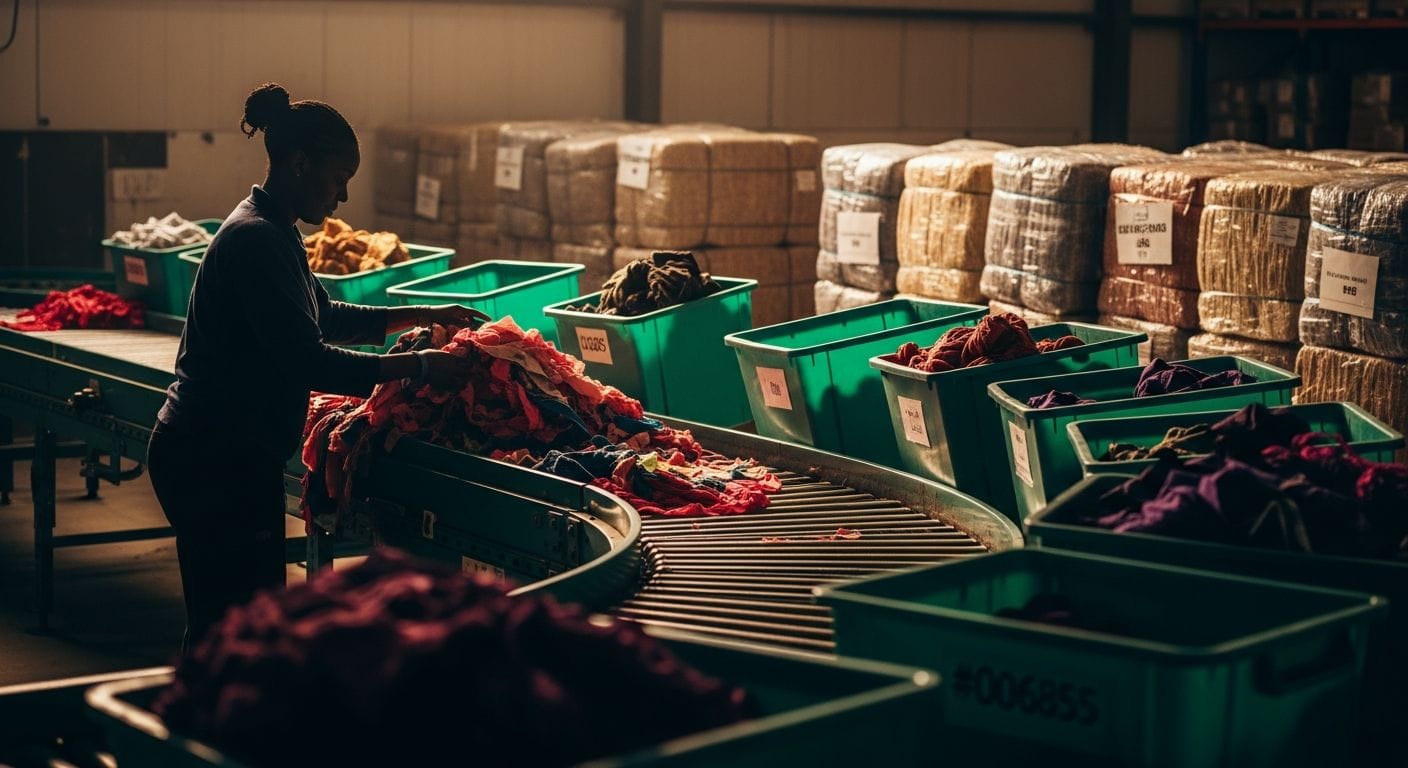
Most EU schemes allow producers to discharge their take-back obligation by paying into a collective scheme managed by their PRO. Refashion, for example, uses member contributions to fund a national network of textile collection points (the yellow Refashion bins you see in French supermarket car parks). You don't need to run your own collection infrastructure — you're funding the collective one.
But here's the thing: beyond the minimum legal requirement, brands that run their own take-back programmes get something collective schemes don't give you — customer data, brand loyalty, and a closed-loop material stream. Patagonia's Worn Wear programme is the obvious benchmark. For a smaller brand, a simpler in-box return envelope or a partnership with a textile sorter can achieve the same principle at lower cost.
For the EU's July 2026 destruction ban specifically, your options for unsold inventory are:
- Resale via secondary channels — outlet sections, third-party resale platforms (Back Market equivalents for clothing, recommerce partners)
- Donation to registered charities — allowable under the ban, subject to documentation requirements
- Recycling via certified textile recyclers — you need a documented chain of custody; the recycler needs to be certified under the relevant scheme
- Rental or subscription models — longer-term, but an option some brands are building into their offer
Managing end-of-season inventory proactively — using AI demand forecasting to reduce overstock in the first place — is genuinely the most cost-effective compliance strategy here. Less unsold stock means fewer destruction-ban problems.
And if you're managing returns — which for apparel brands typically run at high rates — those returned garments that can't be resold also fall within your obligations. We've covered the operational side of this in our returns management guide.
Implementing EPR Reporting Into Your Operations Stack
The data problem is the hardest part. EPR schemes don't want your gut feeling about how many kilos of cotton you sold into France last year — they want precise figures, by material category, by weight, by jurisdiction, reconcilable against your sales records. Getting that right manually, at scale, across multiple channels, is genuinely difficult.
The gap that kills brands at declaration time is the disconnect between their e-commerce platform (Shopify, Amazon Seller Central) and any kind of compliance-ready data structure. Shopify product records don't natively store fibre composition weights. Amazon doesn't auto-segment your sales by EU member state in a format PROs accept.
This is exactly what Ceendesis Textile Compliance is built for. It pulls sales data from your channels — including Shopify, Amazon, and others via our integrations — and structures it against the material and weight data you hold at the SKU level to produce jurisdiction-ready reports for Refashion, Netherlands UPV, and the California scheme.
The practical workflow looks like this:
- Enrich your SKU records with material composition (fibre type, percentage, weight per unit) — a one-time data input task
- Connect your sales channels so the system tracks quantities sold by market in real time
- At declaration time, generate pre-formatted reports by scheme — no manual aggregation, no spreadsheet gymnastics
- Use the fee calculator to model eco-modulation impact before you confirm the declaration, so you can flag any discrepancies
Operations managers handling multi-channel inventory across Shopify and Amazon often find that getting this data infrastructure in place also improves their general stock visibility — because you're forcing a level of SKU-level rigour that pays dividends beyond compliance. Our IMS features sit alongside the compliance tools for exactly this reason.
If you're earlier in your tech stack journey — still on spreadsheets, or using a basic inventory tool that doesn't connect to compliance workflows — our omnichannel vs multichannel guide covers the infrastructure decisions worth making before you add compliance reporting on top.
Frequently Asked Questions
What is the EU strategy for sustainable textiles?
The EU Strategy for Sustainable and Circular Textiles, adopted in 2022, is a package of measures aimed at making textiles produced and sold in the EU more durable, repairable, recyclable, and sustainably made by 2030. It includes the revised Waste Framework Directive's mandatory EPR schemes for textiles, the EU Ecodesign for Sustainable Products Regulation (ESPR) requirements for textile durability and repairability, Digital Product Passport (DPP) obligations for providing material and sustainability information, and the ban on destroying unsold consumer textiles. Together, these form the legislative backbone of what the EU calls the transition to a circular economy for fashion.
Do online sellers have to comply with textile EPR?
Yes — online sellers (including Shopify and Amazon sellers) who sell into covered markets are defined as "producers" under most textile EPR laws and have the same obligations as physical retailers. Distance selling rules don't create an exemption; if you're placing product on a market, you're responsible. This applies to the EU member state schemes under the revised Waste Framework Directive and to California's SB 707.
What are eco-modulated EPR fees?
Eco-modulated EPR fees are levy rates that vary based on the environmental profile of the products you're registering — so brands with more sustainable products pay less per tonne than brands with less recyclable or more hazardous products. In textile EPR schemes like France's Refashion, the modulation criteria typically cover recyclability (mono-material vs. blended fibres), percentage of recycled content, presence of REACH-restricted substances, and durability indicators. The practical implication is that product design decisions — material choices, construction methods — directly affect your annual fee liability.
How do I register for textile EPR in California?
Producers must register with CalRecycle under California's SB 707 (Responsible Textile Recovery Act) and join an approved Stewardship Organisation; the registration deadline is July 1, 2026. CalRecycle's producer registration portal is at calrecycle.ca.gov — you'll need to provide company details, an estimate of textiles placed on the California market, and select a compliant Stewardship Organisation. If you're an overseas brand selling into California via e-commerce, you're still required to register; there's no exemption based on business location.
The Bottom Line
Textile EPR compliance in 2026 is a multi-jurisdiction operational programme, not a single registration you tick off and forget. The brands getting this right have done three things: mapped their obligations by market, built material data into their product records, and connected their sales systems to their compliance reporting. The brands struggling are treating it as an annual admin task rather than a continuous data process.
The July 2026 deadlines — both the California registration and the EU destruction ban — are hard stops. If you haven't started, start today. See how Ceendesis Textile Compliance works, or if you want to understand the broader operational picture first, our inventory management tools for operations managers show how the compliance and inventory layers connect.