
How to File Your 2026 Ecoembes Declaration in Spain

If you sell packaged goods into Spain — from a Shopify store, an Amazon seller account, or anywhere else — you have a legal obligation under Royal Decree 1055/2022 that most foreign brands quietly ignore until a compliance firm sends them a nasty letter. That obligation is the Ecoembes annual declaration: a formal report of every gram of packaging you've placed on the Spanish market, used to calculate the Green Dot fees you owe for financing household packaging waste collection. Miss it, and you're not just non-compliant — you're exposed to fines that Spanish authorities have been increasingly willing to issue as the post-2022 framework matures.
This guide walks you through the actual process — registration, data prep, fee calculation, and submission — in the order you'll do it. No vague references to "the platform." No "consult a specialist." Just the steps, with the specifics you need.
What is the Ecoembes Declaration? (And Who Must File in 2026)
The Ecoembes annual declaration is the formal mechanism by which producers report the weight of packaging they've placed on the Spanish household market. Ecoembes is Spain's primary Packaging Producer Responsibility Organisation (PRO) — a non-profit funded by member companies that manages household packaging waste collection and recycling across Spain.
Under Royal Decree 1055/2022 — which transposed the EU Packaging and Packaging Waste Regulation into Spanish law and significantly expanded its scope — any entity that manufactures, imports, or sells packaged products to end consumers in Spain is classified as a producer. That includes:
- UK and EU brands selling direct-to-consumer via Shopify or their own website
- Amazon FBA sellers whose products are stored in and shipped from Spanish fulfilment centres
- Brands using a Spanish distributor or fulfilment partner (though the obligation can be transferred — see Step 1)
- Brands selling B2C via Spanish marketplaces like El Corte Inglés online
And here's the threshold question everyone asks: is there a de minimis exemption? The short answer is no — not in the way Germany's VerpackG operates. Royal Decree 1055/2022 doesn't include a volume-based exemption from PRO membership. If you're placing packaged goods on the Spanish household market, you're in scope. We've written more about how this sits within the broader European picture in our guide to e-commerce EPR compliance.
The declaration covers packaging used for household products (not industrial/commercial packaging destined for other businesses). If you sell to consumers, assume your packaging is in scope.
Key 2026 Deadlines & Regulatory Updates (Royal Decree 1055/2022)
The declaration filed in 2026 covers the 2025 reporting year (January 1 to December 31, 2025). The submission window for that declaration runs from January 1, 2026 to April 2, 2026 — that window is now closed, but understanding it matters because the 2026 reporting year is already accumulating and your next declaration opens January 1, 2027.
But don't treat this as a problem for future-you. The data you need — weights by material type, per SKU — has to come from somewhere, and that somewhere is your operations data. If you're not capturing packaging weights now, you'll be scrambling next January.
Key 2026 regulatory context under RD 1055/2022:
- The decree formally replaced the older RD 782/1998 and RD 252/2006, consolidating all packaging EPR obligations into a single framework
- MITERD (Ministerio para la Transición Ecológica y el Reto Demográfico) maintains the official producer registry — registration is mandatory before you can join Ecoembes
- The regulation introduced stricter eco-modulation rules: Green Dot fee rates are now adjusted based on recyclability, recycled content, and packaging optimisation — not flat rates across a material category
- Single-use plastics obligations under Spanish Law 7/2022 run alongside packaging EPR and may apply separately depending on your packaging types
Frankly, the eco-modulation piece is where most brands get caught out — assuming last year's fee rate applies to this year's packaging without checking whether their materials qualify for a rebate or surcharge.
Step 1: Appointing an Authorized Representative & Registering with MITERD
Foreign companies — UK, US, Australian, or any non-Spanish entity — cannot file the Ecoembes declaration directly. You must appoint an authorized representative (representante autorizado) established in Spain. This person or entity acts as your legal point of contact for all packaging EPR obligations in Spain, including MITERD registration and Ecoembes membership.
The registration sequence runs like this:
- Appoint your Spanish representative. This is typically a compliance consultant, logistics partner, or specialist firm. The appointment must be formalised — a letter of authorisation isn't sufficient; you'll need a notarised power of attorney in many cases.
- Register with MITERD's RPEAP. The Registro de Productores de Envases y Aparatos de Puesta en el Mercado is the national producer registry. Your representative submits this registration on your behalf. You'll receive a NIMA (Número de Identificación Medioambiental) — your environmental ID number, needed for everything else.
- Join Ecoembes as a member. With your NIMA in hand, your representative registers you on the Ecoembes platform (empresas.ecoembes.com) and activates your annual declaration account. Membership requires signing an adhesion contract with Ecoembes and agreeing to their system financing terms.
This whole process takes two to six weeks depending on your representative's responsiveness and whether any documents need notarisation or apostille. Don't start this in mid-March if you want to hit a March deadline.
When we were running our own brands, the thing that consistently tripped us up wasn't the forms themselves — it was the chain of dependencies. You can't register with Ecoembes until you have a NIMA. You can't get a NIMA without a representative. Sort the representative first, before anything else.
Step 2: Calculating Your 2026 Green Dot Fees by Material
Green Dot fees (the Punto Verde) are the core financial obligation of Ecoembes membership. They're calculated based on the total weight of packaging — by material type — that you placed on the Spanish household market during the reporting year. The fee rate varies by material and, since RD 1055/2022 introduced eco-modulation, by packaging attributes.
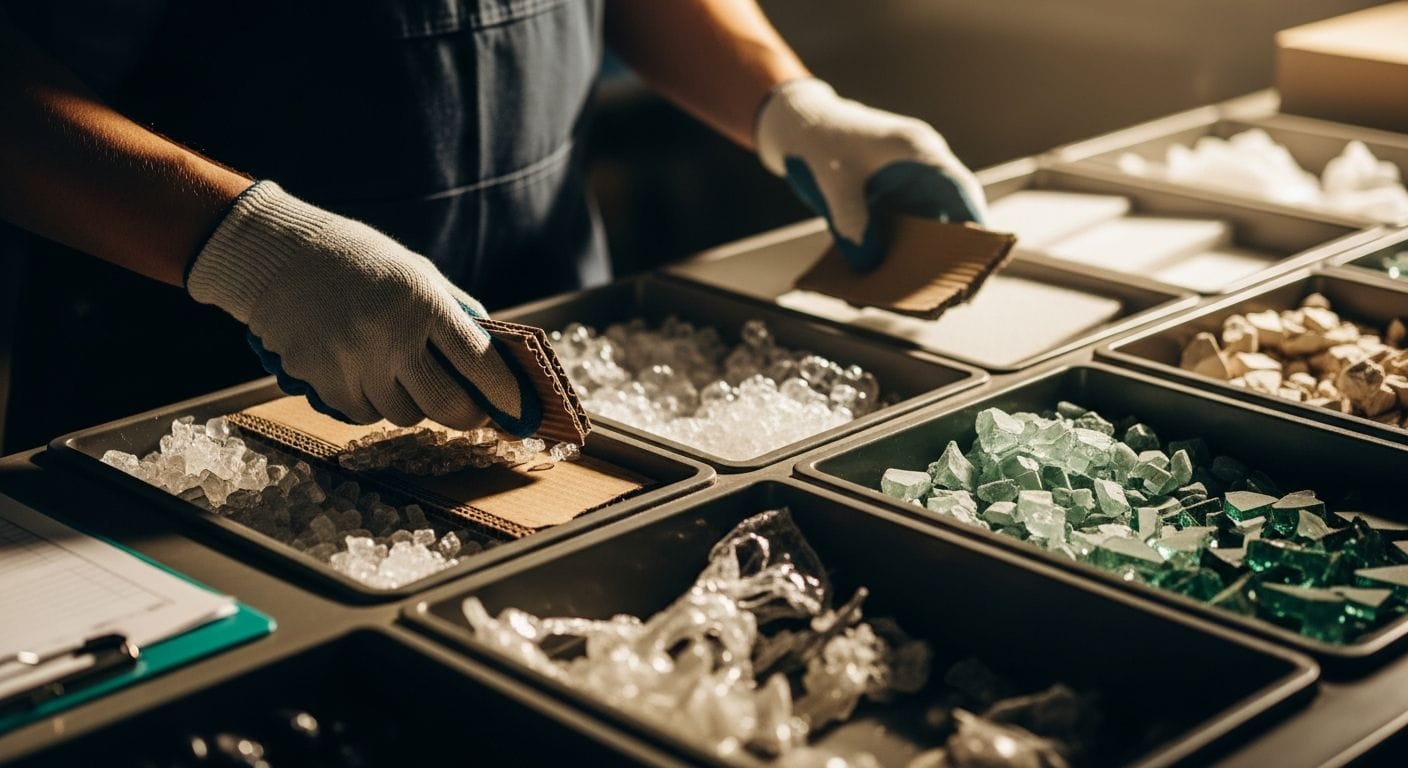
Ecoembes publishes annual tariff tables. Here's a representative comparison of the material categories and how they stack up (note: Ecoembes adjusts these annually — always verify against the current published tariffs before filing):
| Material Type | Example Packaging | Base Fee Approach | Eco-modulation Impact |
|---|---|---|---|
| Plastic film/flexible | Polybags, pouches, shrink wrap | Higher base rate (harder to recycle) | Surcharge if non-recyclable; rebate for recycled content |
| Rigid plastic (PET, HDPE) | Bottles, trays, pots | Mid-range base rate | Rebate for >30% recycled content |
| Corrugated cardboard | Shipping boxes, mailers | Lower base rate | Minimal eco-modulation for standard kraft |
| Glass | Jars, bottles | Low per-kg rate (easily recyclable) | Rebate for high recycled content |
| Steel/aluminium | Tins, cans, foil lids | Mid-range rate | Rebate for closed-loop recycled content |
| Composite/multi-material | Laminated pouches, Tetra Pak | Highest base rate | Surcharge; declared by dominant material weight or split by component |
The composite/multi-material case is where most e-commerce brands get confused. A laminated coffee pouch, for example, combines PET film, aluminium foil, and a PE sealer layer. RD 1055/2022 requires you to either declare by the dominant material (by weight) or — if you have the data — split it by component. Splitting is more accurate and sometimes produces a lower total fee, but it requires detailed packaging specs from your manufacturer.
The practical prep work here: get a packaging audit done before your reporting window opens. For every SKU you sell into Spain, you need the weight (in grams) of each packaging component — primary pack, secondary pack, transport packaging if it reaches the household. Multiply that by units sold in Spain during the year. That's your declaration input data. Our EPR packaging compliance tool can pull this directly from your Shopify or Amazon order data, mapped against your SKU packaging specs.
Step 3: A Walkthrough of the Annual Declaration Process
Once you're registered and have your packaging weight data ready, the actual declaration happens inside the Ecoembes business portal (empresas.ecoembes.com). Your representative will have access credentials — as a foreign brand, you'll typically be working through them, though some brands request direct portal access in addition.
Here's what the process looks like in practice:
Logging In and Finding Your Declaration
The portal presents your account dashboard on login. Your annual declaration for the previous reporting year appears as an active task during the January–April window. It won't be visible outside that window (you can't submit early or late through the standard portal — amendments require a separate process).
Entering Packaging Data by Material Category
The declaration form is structured by material type. For each category (plastic, paper/cardboard, glass, metals, composite, other), you enter the total weight in kilograms placed on the Spanish household market during the reporting year. This is where your pre-calculated packaging data feeds in directly.
Common edge cases you'll encounter:
- Import packaging: If you import products already packaged and sell them in Spain, you declare as the importer/first putter-on-market. The packaging is yours to declare, even if you didn't manufacture it.
- Promotional items: Free gifts, sample sachets, and promotional items included with orders count as packaging placed on the market. Include them.
- Returns: If a packaged product is returned unopened, the packaging has technically already been placed on the market — most operators do not deduct returns, and Ecoembes guidance supports this approach.
- Amazon FBA: If Amazon is storing and shipping your inventory from Spanish fulfilment centres, Amazon handles its own transport packaging (their boxes, tape, void fill). You're responsible for your product's primary and secondary packaging. Amazon's Seller Central compliance dashboard won't file your Ecoembes declaration — that's still on you.
Reviewing the Fee Calculation
After data entry, the portal generates a fee estimate based on the tariffs in force for the reporting year. Review this carefully against your own calculation — discrepancies usually trace back to material classification errors (e.g., flexible plastic miscategorised as rigid plastic). Correct before submitting, not after.
Submitting and Receiving Confirmation
Once submitted, you receive a declaration reference number and a confirmation PDF. Keep this. It's your proof of compliance for that year, and if you're ever audited by a regional environmental authority (comunidades autónomas handle enforcement in Spain), this is what you present.
Payment of the Punto Verde fees follows the submitted declaration — Ecoembes will invoice based on the weights declared. Payment terms vary but are typically due within 30 days of invoicing. If you're managing multiple EU markets simultaneously, our broader EPR compliance guide covers how the German LUCID, French CITEO, and Spanish Ecoembes systems relate to each other.
For fashion brands specifically — if you sell packaged apparel into Spain that also has textile EPR obligations under France's Refashion scheme — see our textile compliance guide for how those two obligations interact.
Frequently Asked Questions
Who is obligated to declare to Ecoembes in Spain?
Any company that places packaged goods on the Spanish household market is obligated to declare under Royal Decree 1055/2022, regardless of where the company is based. This includes UK, US, and other non-EU brands selling direct-to-consumer in Spain via e-commerce, as well as domestic manufacturers and importers. There is no minimum volume threshold exempting small producers from membership and declaration.
How is the annual Ecoembes packaging declaration submitted?
The annual declaration is submitted through the Ecoembes business portal (empresas.ecoembes.com) during the January 1 to April 2 window (for the preceding year's data). Foreign companies must submit through an appointed Spanish authorized representative. The form requires packaging weight data broken down by material type for all household packaging placed on the Spanish market during the reporting year.
What is the Green Dot fee for packaging in Spain?
The Green Dot fee (Punto Verde) is calculated by multiplying the weight of each material type declared (in kilograms) by the applicable tariff rate set by Ecoembes for that year. Rates vary by material — with flexible plastics carrying the highest rates and glass among the lowest — and are further adjusted by eco-modulation factors under RD 1055/2022 based on recyclability and recycled content. Ecoembes publishes the official tariff table annually; always use the current year's published rates for your calculation.
Do foreign companies need to comply with Spanish packaging laws?
Yes — foreign companies selling packaged products directly to consumers in Spain are subject to Spanish packaging EPR law under Royal Decree 1055/2022. They must appoint a legally authorized representative based in Spain, register with MITERD's producer registry to obtain a NIMA number, and join a PRO such as Ecoembes. Selling through a Spanish distributor can transfer the obligation, but only if the transfer is explicitly contractually documented and the distributor accepts the producer role in writing.
Automating Spanish EPR Compliance with Ceendesis
The declaration itself takes a few hours if your data is clean. The real work — and the real risk — is in the data preparation. Getting packaging weights per SKU, mapping them to Spanish sales volumes, handling multi-material classifications, and keeping records audit-ready year-round: that's where brands lose time and make errors.
And the volume problem compounds fast. If you're running Shopify alongside Amazon with hundreds of SKUs, manually aggregating packaging data from both channels for an annual declaration is genuinely unpleasant. Most operations managers we speak to are doing this in Excel, pulling exports from two or three platforms, reconciling them, then doing the material weight maths by hand. That's a significant source of error.
Ceendesis Packaging Compliance integrates directly with your Shopify and Amazon data. You define your packaging specs per SKU once — material type, component weights, recyclability attributes — and the platform tracks your Spanish (and German, French, UK) EPR obligations in real time as orders flow through. When the Ecoembes declaration window opens, your weights are already calculated, broken down by material, and ready to export in the format the portal requires.
It also handles the multi-market picture. If you're filing for Spain and Germany simultaneously (VerpackG declarations run on a different calendar, with quarterly reporting obligations), our integrations keep the data unified rather than siloed per market. You can see our full feature set here.
For brands managing warehouse operations alongside compliance — tracking inventory across locations, handling returns, syncing stock across channels — our inventory management system connects those operational data streams directly, so your packaging declaration data doesn't live in a separate spreadsheet divorced from your actual stock movements. We've written about how good operational data hygiene pays dividends in our workflow automation guide — the same principle applies here.
The Spanish market is one of Europe's largest e-commerce markets, and enforcement under RD 1055/2022 is tightening. The brands that treat Ecoembes compliance as a January panic rather than a year-round data practice are the ones paying correction fees and scrambling for packaging specs from suppliers who've since changed their materials. Start collecting the data now. File accurately in January. And if you're the operations manager holding all of this together, you shouldn't be doing it manually.