
2D Barcode Fulfillment Guide for 2026
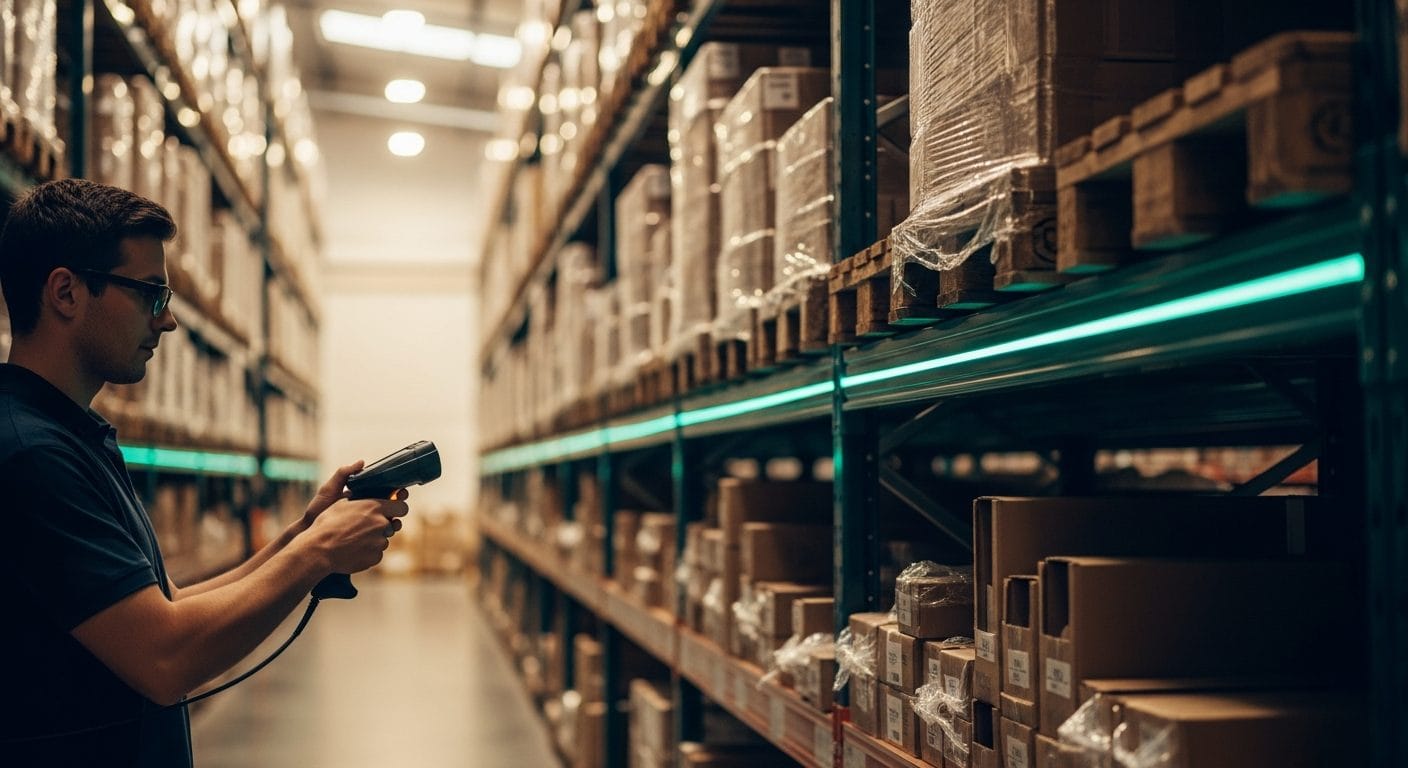
Your warehouse scanner probably can't read the barcodes that will be mandatory in 18 months.
Not a scare tactic. Just where things stand in mid-2026.
GS1 Sunrise 2027 means that by the end of next year, every retail point-of-sale system in the world needs to read and process 2D barcodes. Most e-commerce brands are still printing 1D UPC labels, running laser scanners that physically cannot decode a QR code or DataMatrix symbol, and using warehouse software that was never built to handle batch numbers or expiry dates embedded in a barcode. That gap will cause problems — stockouts, compliance failures, Amazon receiving delays. The brands that close it early will have a real operational advantage.
This guide is for operations managers who need to actually do something, not just understand what 2D barcodes are. We'll cover what's changing, what hardware and software you need, and how to wire 2D scanning into your fulfillment workflow — whether you're running Shopify alongside Amazon, shipping DTC, or managing B2B wholesale.
What are 2D barcodes and why are they replacing 1D?
A 1D barcode — the striped UPC or EAN you've been scanning for decades — encodes data horizontally. That's it. According to GS1 US, a 1D barcode holds enough characters for a product identifier and nothing more. A 2D barcode encodes data both horizontally and vertically, so a single symbol can carry thousands of characters: URLs, batch numbers, expiry dates, lot codes, country of origin.
The two formats you'll encounter most in e-commerce fulfillment are QR codes and GS1 DataMatrix. QR codes are familiar to anyone with a smartphone. DataMatrix is what GS1 is pushing for retail — compact, highly damage-resistant, and readable even when up to 30% of the symbol is obscured or torn.
Here's the thing: this isn't a gradual evolution. It's a hard cutover. And the operational implications go well beyond slapping a different sticker on a box.
| Feature | 1D Barcode (UPC/EAN) | 2D Barcode (QR / DataMatrix) |
|---|---|---|
| Data capacity | ~20 characters | Thousands of characters |
| Data types | Product ID only | GTIN, batch, expiry, lot, URL, serial |
| Scan direction | Must align horizontally | Omnidirectional |
| Hardware required | Laser or CCD scanner | Image-based (2D imager) scanner only |
| Damage tolerance | Low — single stripe damage fails | High — error correction built in |
| Consumer-facing use | None | Links to product info, sustainability data, DPP |
| GS1 Sunrise 2027 ready | No | Yes |
The consumer-facing angle is worth flagging — especially for brands selling into the EU. Digital Product Passports (DPP), coming into force progressively from 2026 onward, use 2D codes to deliver product lifecycle data to consumers and regulators. If you're already thinking about textile compliance for EU markets, 2D barcodes aren't optional infrastructure — they're the delivery mechanism for mandatory data.
The GS1 Sunrise 2027 initiative: what e-commerce brands need to know
GS1 Sunrise 2027 has one headline goal: by the end of 2027, all retail point-of-sale systems globally should be capable of reading and processing a defined set of 2D barcodes compliant with GS1 standards. That's a direct quote from GS1's own documentation. The initiative covers POS — but the supply chain implications run much further upstream.
What does "capable of reading" actually mean for a warehouse? It means your receiving stations, pick-and-pack scanners, and shipping verification systems all need to be 2D-ready too. Because if a supplier ships you goods labelled with DataMatrix codes and your inbound scanner is a 2003-era laser gun, those items hit your floor unverified. That creates phantom stock, receiving discrepancies, and the kind of inventory drift that takes weeks to reconcile. We covered exactly this problem in our Real-Time Inventory Sync Guide for 2026.
And Amazon is already moving. Starting March 31, 2026, Amazon changed its FBA barcode requirements: resellers must now use Amazon barcodes (FNSKUs), even when the product carries a manufacturer barcode. Brand owners can still use manufacturer barcodes — but resellers lost that option. Amazon is forcing a cleaner data trail on every item entering their FCs, and it's a preview of where the entire retail ecosystem is heading.
But here's what most articles miss: Sunrise 2027 affects every channel, not just FBA. If you're selling into UK retailers, European wholesale accounts, or Walmart's marketplace, their inbound requirements are shifting on roughly the same timeline. Retailers want batch numbers and expiry dates embedded in the barcode, not typed manually into a portal.
The brands that treat this as a labelling upgrade alone will struggle. It's a data infrastructure upgrade — one that touches your label templates, your scanner fleet, your WMS, and your supplier relationships, all at once.
Step-by-step: implementing 2D barcodes in your fulfillment workflow
Most brands overthink the implementation and stall. Here's a practical sequence that works for operations teams of 5 to 50 people.
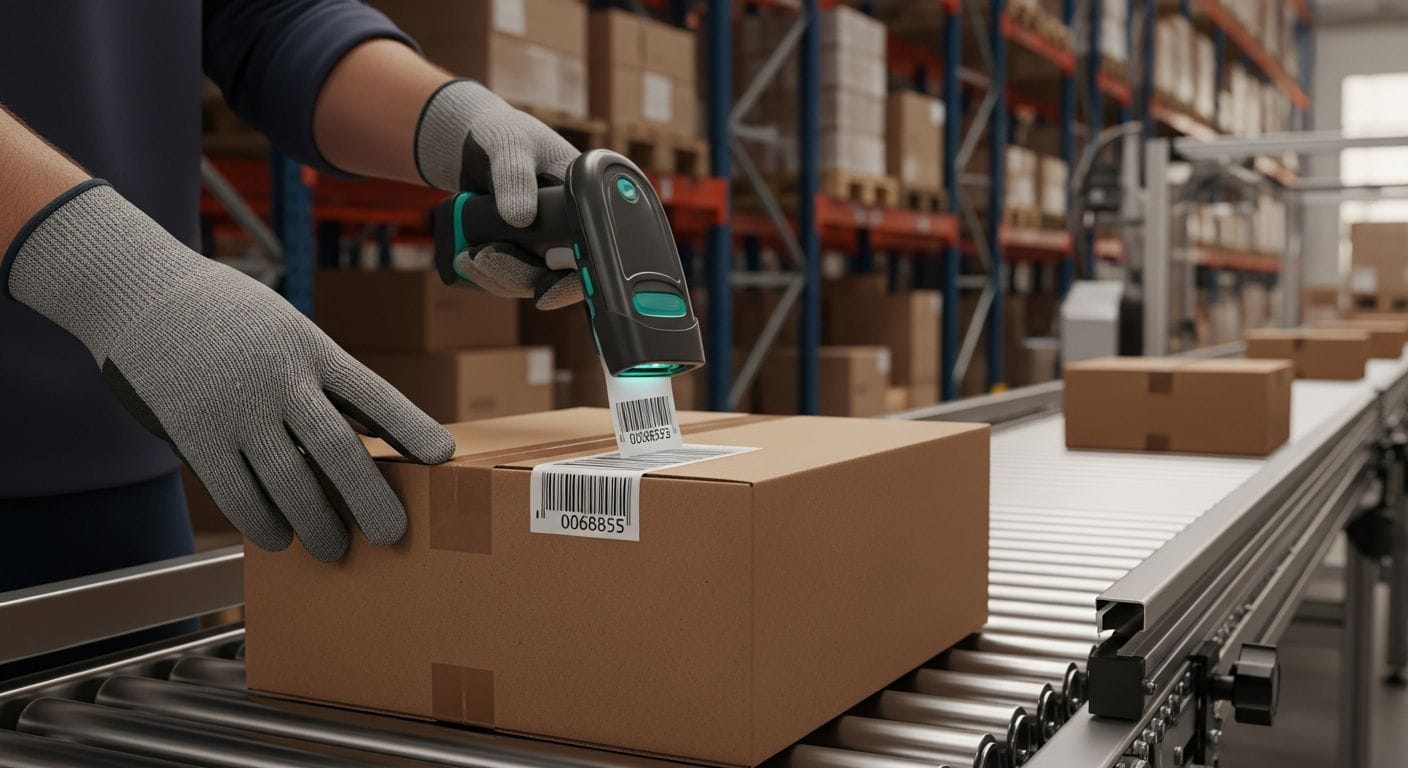
Step 1: Audit your current scanner hardware
Traditional laser scanners physically cannot read 2D barcodes. Full stop. Image-based (2D imager) scanners — like the Zebra DS2208, Honeywell Xenon XP, or comparable models — read both 1D and 2D symbologies. Walk your warehouse and list every scanning device: handheld scanners, fixed mount readers at conveyor stations, mobile computers on forklifts. Anything running a laser goes on the replacement list. Budget roughly £150–£300 per handheld unit for a mid-range 2D imager — these aren't exotic hardware anymore, the price has come down substantially.
Step 2: Update your label templates
Your label design needs to output a GS1 DataMatrix or QR code that encodes the correct GS1 Application Identifiers (AIs) — the structured data fields that tell a scanner what each piece of data means. For a typical consumer product, you'll encode: GTIN (AI 01), expiry date (AI 17), lot/batch number (AI 10). Your label software (Bartender, Loftware, ZPL-based templates) should support GS1 encoding natively. If it doesn't, that's a software problem to fix before you print a single new label.
Step 3: Test before you roll out
Print 50 test labels. Scan them on your new hardware. Verify the decoded data matches what you intended to encode. Then scan them on your customers' systems too — particularly if you're shipping to major retail accounts. Do this with damaged labels, wrinkled labels, and labels at odd angles. You're stress-testing the system, not just confirming it works in ideal conditions.
Step 4: Update your WMS and IMS to ingest the new data fields
This is where most implementations stumble. Scanning a DataMatrix code that contains batch and expiry data is useless if your warehouse software reads it as a GTIN and throws the rest away. Your inventory management system needs to be configured to receive, store, and act on those additional fields — linking lot numbers to purchase orders, flagging approaching expiry dates, and surfacing batch data in pick lists.
When we were building out operations processes for our own brands, this was the exact point where generic WMS platforms fell over. They'd parse the GTIN fine and silently discard everything else. That's not a scanning problem — it's a data schema problem. Ask your software vendor directly: "Can you ingest GS1 Application Identifier data from a 2D scan and store it against the inventory record?"
Step 5: Train your team — briefly
Good news: if you've got the right hardware, the physical scanning process is almost identical to 1D. The difference is in the data review on-screen. Your team needs to know to check that batch and expiry fields populate correctly on receiving, and to flag any scan that returns incomplete data. An hour of training per shift, with a reference card at each station, is enough.
If you're managing wholesale and multi-channel inventory simultaneously, brief your 3PL partners too — their scanners and WMS matter just as much as yours.
Integrating 2D barcode scanning with your inventory management system
Getting a scanner to decode a 2D barcode is the easy part. Getting that decoded data to flow cleanly into your inventory system — and then act on it — is where the real work happens.
Modern multi-channel inventory management platforms need to handle 2D barcode data across every touchpoint: inbound receiving, put-away, pick confirmation, and outbound shipping verification. Each scan should update stock levels in real time, log the lot number against the incoming PO, and write the expiry date to the product record. If your platform can't do that, you're running 2D hardware on a 1D data model — which defeats the purpose entirely.
AI-powered scanning is also worth understanding. According to Anyline's research published in 2025, AI-powered solutions use advanced computer vision and machine learning to interpret what they're seeing even when the image is far from perfect. In a real warehouse — where labels get smeared, stretched, or partially covered by tape — that matters. A traditional imager throws a read error. An AI-powered reader makes a probabilistic interpretation and flags low-confidence reads for human review rather than failing silently.
What does this look like on a busy day? A picker scanning 300 units per hour will hit maybe 3–5 problematic labels. With a standard imager, those are dead stops — the scanner beeps, the picker re-scans, loses time, sometimes manually overrides. With an AI-assisted reader, those items go to a supervisor queue and the picker keeps moving. The throughput difference on a busy dispatch shift is real.
For operations managers running mixed-channel fulfillment, the integration checklist looks like this:
- Confirm your IMS has API endpoints for lot, batch, and expiry data — not just GTIN
- Map GS1 Application Identifiers to your product data schema
- Set up automated alerts for approaching expiry dates at the SKU/lot level
- Configure your outbound shipping module to include batch data in ASNs (Advanced Shipment Notices) to retail customers
- Verify your 3PL's WMS can receive lot-level data if you're using outsourced fulfillment
This connects directly to broader inventory accuracy work — we covered the downstream effects in our Dynamic Safety Stock guide for 2026. When your lot-level data is clean, your safety stock calculations become significantly more reliable because you're not accidentally counting near-expired stock as usable inventory.
See how Ceendesis IMS integrates with your existing tools — including scanner hardware, Shopify, Amazon, and ERP platforms — without requiring a wholesale system replacement.
What comes after 2D barcodes: AI, computer vision, and hybrid RFID solutions
2D barcodes aren't the final destination. They're a step toward fully automated product identification — and the next few years will see 2D codes working alongside RFID, computer vision, and AI-driven demand systems in ways that would have seemed over-engineered for an SME just three years ago.
RFID and 2D barcodes solve different problems, and the most sophisticated fulfillment operations are using both. RFID excels at bulk reading — wave a reader past a pallet and count 200 items in under a second. But RFID requires a tag per item (cost: £0.10–£0.50 per tag at volume), and a consumer's smartphone can't read it. 2D barcodes are nearly free to print, readable by any camera, and carry rich product data that RFID tags typically don't. The practical split: RFID for inbound bulk receiving and stockroom cycle counting, 2D barcodes for individual item tracking, consumer engagement, and compliance data delivery.
Computer vision ties it together. Cameras mounted at conveyor belts or dock doors read 2D codes at speeds no human-operated scanner can match, simultaneously verify label placement, and flag damaged packaging — all without a picker touching the item. This isn't science fiction for large 3PLs anymore; the hardware cost has fallen to a level where a 10-person warehouse can consider it for a high-velocity SKU line.
And AI demand forecasting — which we explored in our AI Demand Forecasting guide — becomes substantially more accurate when fed lot-level inventory data. If your system knows that 400 units of SKU-X are in lot 2024-11 expiring in 90 days, it can factor that into replenishment timing in a way that GTIN-only inventory data never could.
The brands that will thrive here aren't necessarily the ones with the biggest tech budget. They're the ones with clean data foundations — accurate lot tracking, reliable scan rates, IMS platforms that actually store and use the data their scanners capture. If that's not where you are yet, the omnichannel vs multichannel inventory debate becomes somewhat academic — because neither model works well on dirty data.
How do 2D barcodes connect to packaging compliance? More directly than most people expect. If you're shipping into the EU or UK, your packaging data — material weights, recyclability codes, producer registration numbers — increasingly needs to be machine-readable and product-linked. We covered the packaging side in detail in our guide to EPR packaging compliance.
Frequently asked questions
What is the difference between a 1D and 2D barcode for inventory?
A 1D barcode (like a UPC or EAN) encodes only a product identifier — typically a GTIN — in a linear sequence of bars. A 2D barcode (like a QR code or GS1 DataMatrix) encodes thousands of characters including batch numbers, expiry dates, lot codes, and URLs in a grid pattern. For inventory management, a 2D scan at receiving can automatically populate lot, expiry, and supplier data into your system. A 1D scan gives you only a product ID, and the rest has to be entered manually or pulled from a PO. The practical result is faster, more accurate receiving and dramatically better traceability at the SKU and lot level.
How do I switch my e-commerce business to 2D barcodes?
Switching to 2D barcodes requires four things: replacing laser scanners with image-based (2D imager) scanners; updating your label templates to output GS1 DataMatrix or QR codes with the correct Application Identifiers; confirming your inventory management system can ingest and store lot and expiry data from 2D scans; and verifying your trading partners (retailers, 3PLs, Amazon FCs) can process 2D labels on receipt. The hardware swap is the most straightforward step — modern 2D imagers read both 1D and 2D, so you won't lose backward compatibility. The software integration is where most operations teams hit friction, so start there with your IMS vendor before you change a single label. Check our pricing to see if Ceendesis IMS fits your operation.
What is GS1 Sunrise 2027 and how will it affect online retailers?
GS1 Sunrise 2027 is a global industry initiative — backed by GS1, the international standards body for barcodes — with the goal that by the end of 2027, all retail point-of-sale systems worldwide will be capable of reading and processing 2D barcodes compliant with GS1 standards, alongside conventional 1D codes. For online retailers, the direct impact is twofold: suppliers and retail customers will increasingly expect, and eventually require, 2D-labelled shipments; and Amazon's evolving barcode policies (including the March 2026 FNSKU requirement change for resellers) are an early signal of how quickly fulfilment infrastructure is moving. Brands that delay scanner and software upgrades until late 2027 will face a rushed, expensive transition — starting now means you can phase the investment over 12–18 months.
The transition to 2D barcode fulfillment isn't a distant IT project — it's an operational change that touches your scanner fleet, your label workflow, and the data model inside your inventory system. Get the hardware right, pressure-test your IMS integration, and make sure your team knows what a good scan looks like. If you're running multiple channels and want to make sure your inventory buffers are calibrated for the transition period — when some suppliers will be 2D and some won't — that's worth planning now. Ceendesis IMS is built to handle exactly this kind of mixed-data environment, and our features are designed for the operational reality of growing e-commerce brands — not enterprise warehouses with seven-figure IT budgets.